
19.Nov.26 | From accountability and Iowa’s planned detonation to living-cell computers and holiday boundaries—Sorting Soup makes room for sharp questions, collective courage, and care.
Thursday, 19 November 2026 | Main gathering: 5–6:30 p.m.
🫒 THE ANTIPASTO
Some weeks arrive as a tidy list. This one arrived like somebody had tipped the entire news cupboard into the stockpot…and then tipped the stockpot all over the stove.
Thursday’s Sorting Soup made room for congressional accountability, international law, failing public systems, food prices, environmental fears, scientific communities under strain, and the small matter of making it through the holidays without donating every last scrap of yourself to other people’s expectations.
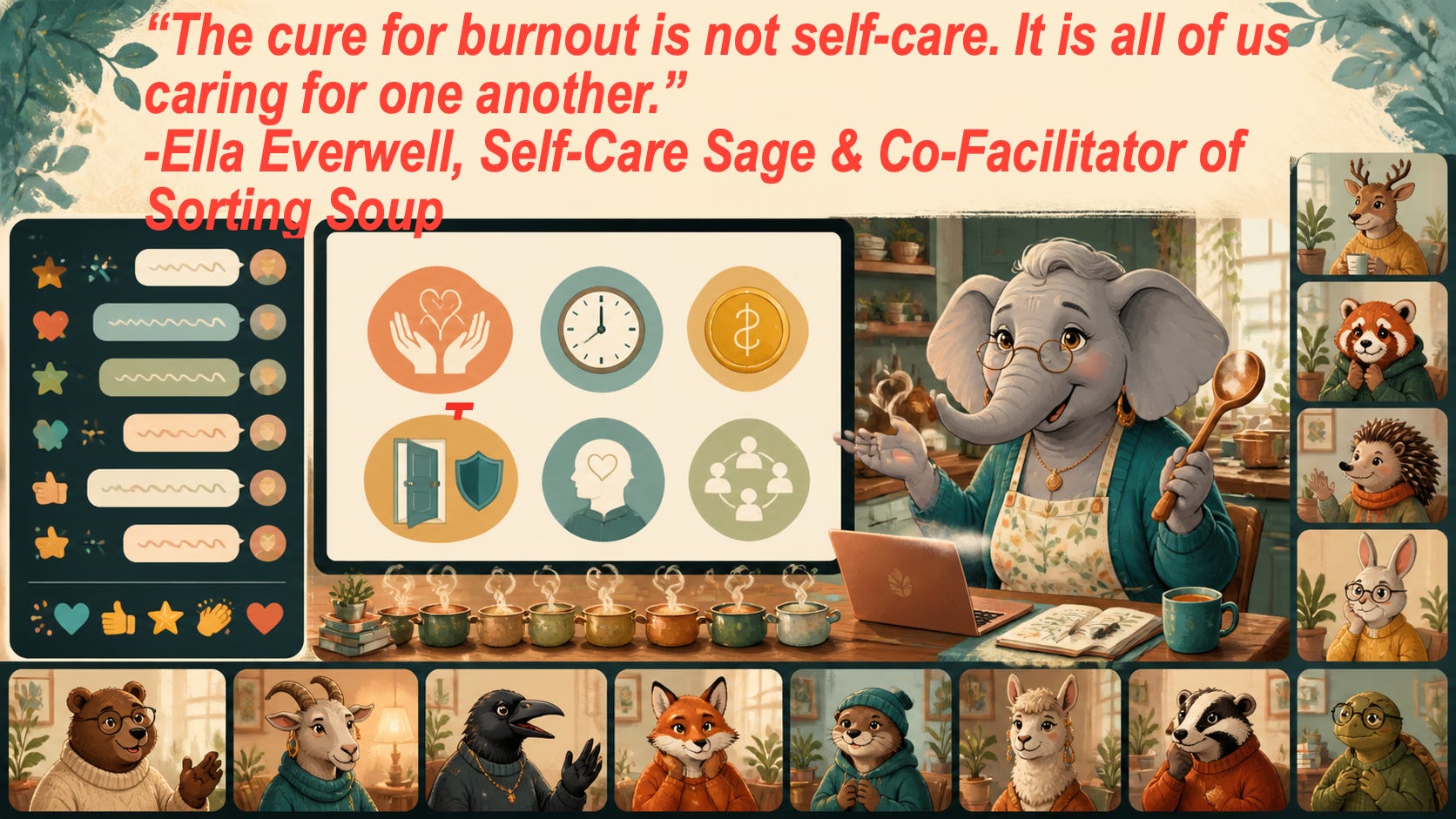
At the table were co-facilitators Alice Everwell, Briar Bearybright, and Dr. Mellow Marigold, with Hazel Hearthprickle helping keep the gathering moving and Sir Talliver Guidelight supporting the livestream. Returning contributors brought legal perspective, organising instincts, local knowledge, honest uncertainty, and enough humour to stop the room from boiling over.
Alice set the standard:
“We can have an emotional response and an analytical response, and we can be angry and still be accurate. We can disagree without treating one another as the enemy.”
The goal was not to memorise every alarming headline. It was to leave with a clearer sense of what mattered, what remained uncertain, and where people could put their energy. Not everything needed an answer that evening. Everything deserved to be approached with care.
Recap note: This newsletter reports participants’ experiences, opinions, and shared resources; it does not independently verify every headline discussed. Private messages and excluded submissions are not used. Community members appear under their designated pseudonyms where supplied; otherwise, they remain anonymous. Public figures retain their names.
Editor’s update: The CL1 section includes two video resources supplied after the meeting. They are clearly distinguished from Thursday’s discussion and public-chat contributions.
🪑 PULL UP A CHAIR: FAMILIAR VOICES & FRESH QUESTIONS
“Come in, come in.” Alice’s welcome made the room’s purpose clear: this was a collective processing space, not a competition to produce the most frightening headline.
The kitchen crew brought complementary strengths:
- 🐘 Alice Everwell, co-facilitator and Self-Care Sage, introduced the research, invited disagreement, and helped turn a sprawling discussion towards choices people could actually make.
- 🐾 Briar Bearybright, co-facilitator and Artful Ambassador & Merch Maven, introduced the group norms and later asked direct, useful questions about environmental risk, constituent pressure, and economic consequences.
- 🌿 Dr. Mellow Marigold, Peaceful Powerhouse & Co-Facilitator of Sorting Soup, guided the opening grounding exercise and contributed analysis of international institutions, congressional leadership, and the wider consequences of scientific migration.
- 🦔 Hazel Hearthprickle, Sorting Soup Steward & Hands-On Guide, was acknowledged for timekeeping and technical support. In chat, she combined accountability, thoughtful follow-up, and affectionate mischief.
- ⚖️ Mr. LEE, Legal Eagle Emeritus, brought the retired-attorney perspective: what legal standards are for, what Congress should investigate, and who can be intimidated along the way.
Returning voices included Ms. Verity Justice Onyx, Drake Dunehaven, Ms. Laurel Lightkeeper, Junia Hearthsong, Tansy Trailwhistle, Kai Harbourlight, Milo Merriquip, and Iris Emberwing. Ms. Beryl Bluejay appeared briefly in the spoken record; Ms. Juniper Jay appeared through a public-chat reaction. Brief participation is acknowledged without turning it into an invented speech.
Other attendees joined through questions, reactions, personal experience, and chat. Those without supplied pseudonyms remain anonymous. The materials do not explicitly identify a first-time speaker, so no one is assigned an invented debut.
One attendee arrived without their usual knitting, explaining that they were safely a passenger rather than driving. Milo Merriquip supplied the appropriate welcome:
“We won’t tell if you knit in your car.”
Briar’s agreements were straightforward: raise a digital hand, stay civil and constructive, avoid chat spam, and bring possible solutions alongside problems. Stepping away was allowed. Coming back was encouraged. Alice noted that the conversation would probably have moved to something different by then.

🌿 DR. MELLOW MARIGOLD: CLEARING SPACE BEFORE FILLING THE BOWL
Dr. Mellow Marigold opened with the Bardo, guiding participants through breathing, body awareness, and a deliberate clearing of mental space.
She did not ask people to deny their worries or solve them on command. Instead, she invited participants to notice what was demanding attention, acknowledge its importance, and imagine wrapping it in something secure—a soft blanket, for example—before setting it aside temporarily.
“Please sit aside for now and I’ll come back to you.”
That was the compassionate distinction: not now did not mean not important. The worries were being given somewhere to rest while their owners made room to think.
After clearing that space, she invited participants to bring something back into it intentionally: a question about the week, a feeling about activism, or something they needed to understand. The exercise ended with fingers and toes moving, eyes blinking, and a return “to the soup”.
Alice thanked her, after finally finder her unmute button, and prepared to fill the newly cleared headspace with the evening’s news. A gentle landing, followed by a substantial serving.
🏛️ ACCOUNTABILITY: MORE THAN AN UNCOMFORTABLE QUESTION
Alice opened the news discussion with House leadership, Hakeem Jeffries, and what participants wanted from the incoming Congress. She distinguished a party nomination for Speaker from the full House election and separated three tools that could easily become muddled: investigations, legislation, and funding decisions.
Her test was about outcomes:
“Accountability cannot just mean that somebody we agree with asks somebody we disagree with an uncomfortable question.”
Would oversight produce documents, a public record, meaningful policy changes, or evidence that supported further action? Or would it stop at a dramatic exchange that worked well as a clip?
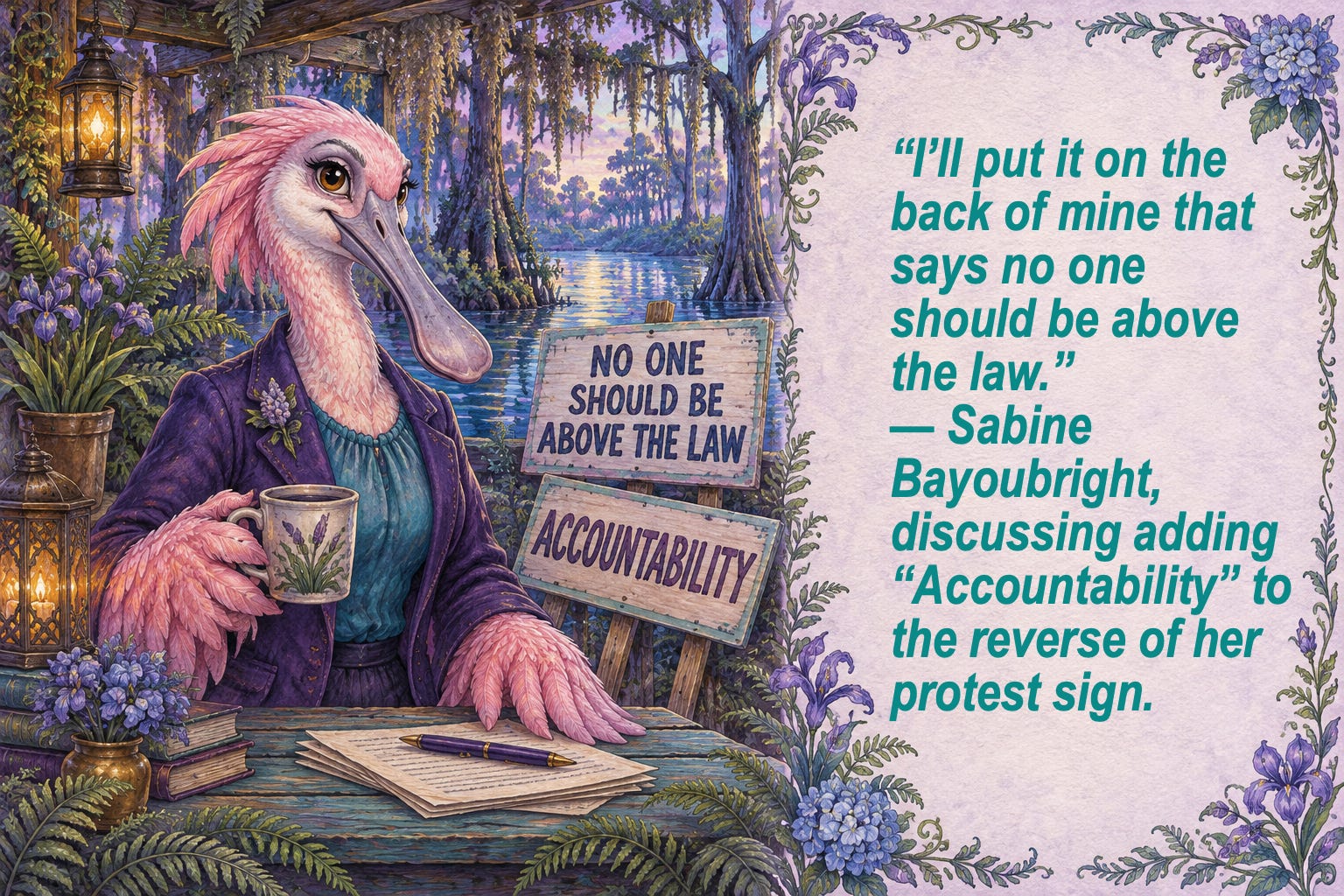
Alice argued that disappointment over a leadership choice should not become paralysis. In her view, organising could still create leverage, and continuing pressure mattered more than treating a nomination as the end of the story. She also praised an Ayanna Pressley response previously shared by Dr. Rally Dazzle, pushing back against criticism that Pressley should have done more.
In public chat, Sir Talliver Guidelight supplied a reported nomination tally. Dr. Mellow Marigold relayed commentary associated with Heather Cox Richardson and Nancy Pelosi about the experience required to bring people together and navigate complicated parliamentary terrain. The emphasis was on institutional skill, not unconditional approval.
🦆 Drake Dunehaven: keep people’s needs in the frame
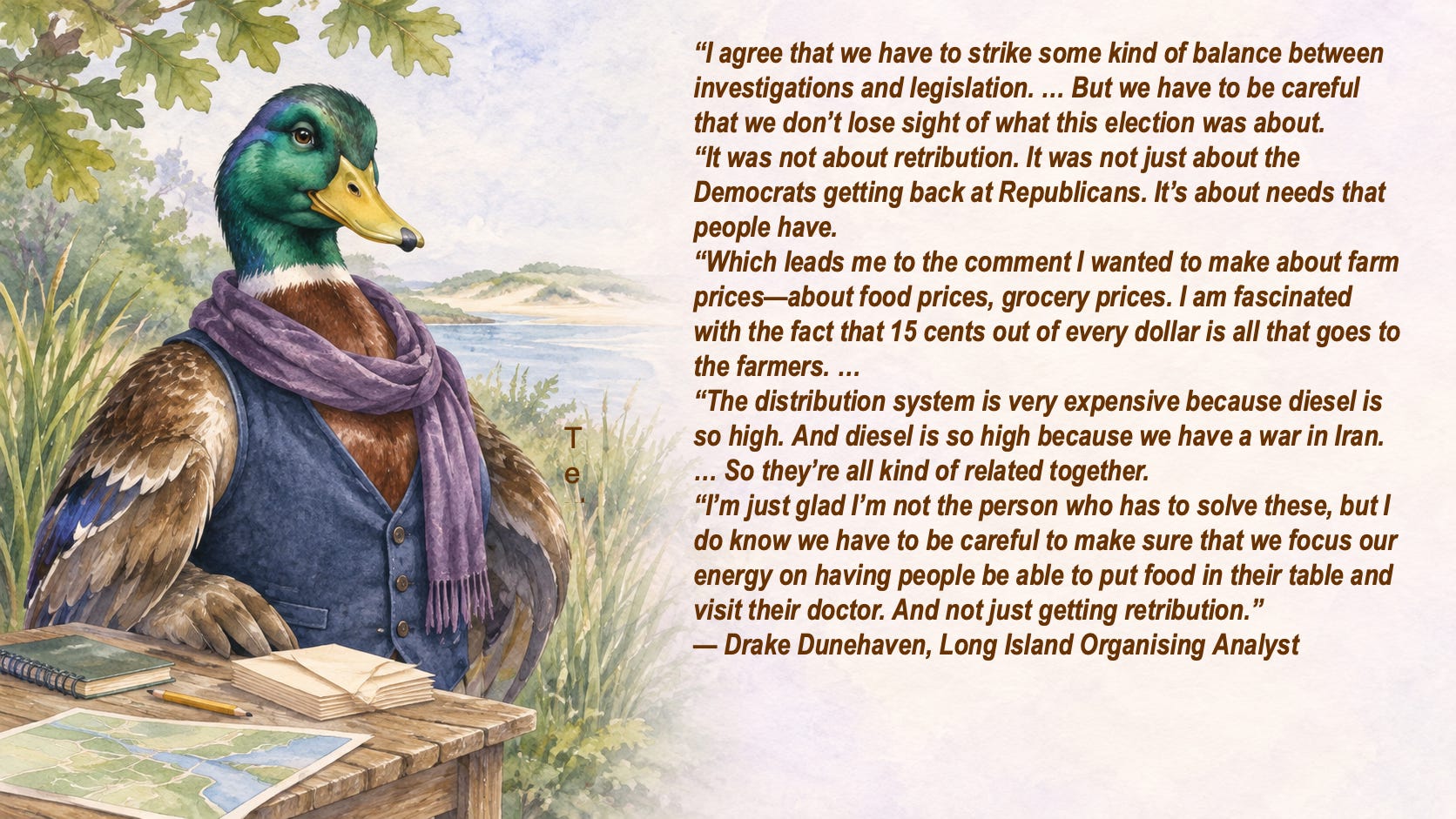
Drake Dunehaven, Long Island Organising Analyst & Ballot-Curing Champion, agreed that investigations and legislation had to be balanced. His warning was against allowing political payback to displace material needs:
“It’s about needs that people have.”
He connected that to food prices and access to healthcare, arguing that the work had to help people put food on the table and visit their doctor. His wider comments linked distribution costs, fuel, and international conflict—an argument about interlocking pressures rather than a verified breakdown of grocery prices.
🦔 Hazel Hearthprickle: accountability is not the same as revenge
Hazel supplied an important counterweight in chat:
“Holding criminals accountable … is not retribution.”
Her point was that people needed to see the law applied to powerful officials just as it would be applied to ordinary people. These contributions did not require a choice between accountability and affordability. They exposed the challenge of doing both without allowing either spectacle or institutional caution to consume the work.
Milo Merriquip urged a team approach, with people following through in their respective roles so multiple challenges could be tackled at once.
⚖️ MR. LEE’S LEGAL DESK: STANDARDS NEED MORE THAN GOOD INTENTIONS
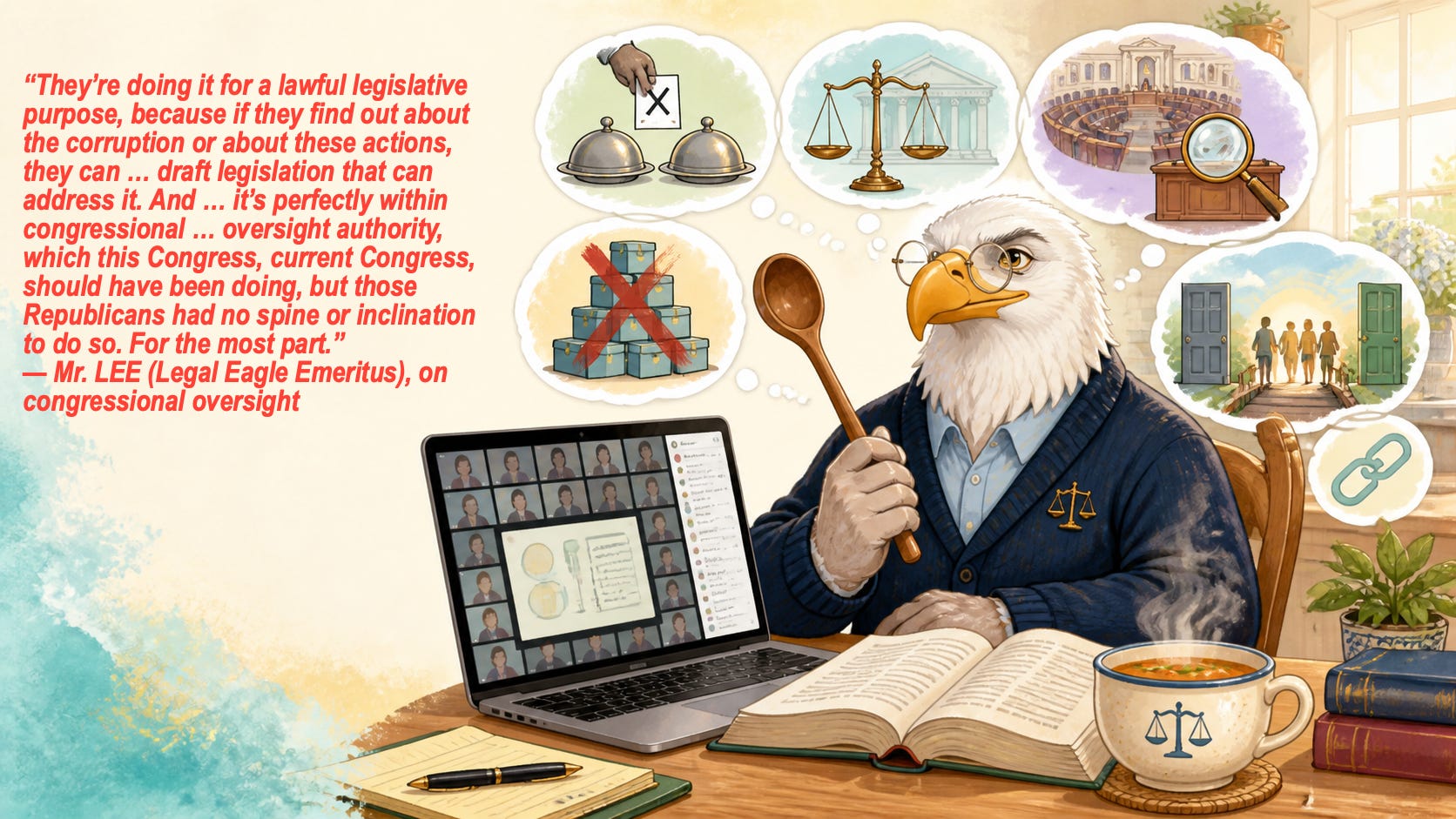
Mr. LEE made two substantial interventions connecting international law, congressional oversight, and the practical conditions under which accountability can happen.
International law cannot depend on whether powerful people enjoy it
Responding to criticism of international courts, he offered a deliberately sharp comparison:
“What would the Nazis have said about Nuremberg?”
His point was that the objections of people facing accountability were not, by themselves, a reason to abandon legal standards. He discussed Ukraine, Gaza, U.S. military actions, and pressure on the International Criminal Court as part of a broader argument for maintaining international constraints.
He also described his understanding of how travel to participating countries could create arrest risks for people sought by the ICC. These were remarks within the discussion, not a comprehensive legal opinion or an independently verified assessment of any particular person’s legal position.
A story about listening to a historical Senate debate over the League of Nations brought the sovereignty argument into focus. Resistance to international institutions had a long history, he noted; declining to join an institution did not erase the need for standards governing relations among countries. He also recalled the role of international maritime law as another example of rules governing conduct beyond national borders.
Oversight is a function—not a favour
Turning to Congress, Mr. LEE described reported threats directed at lawmakers contemplating investigations. He argued that Congress needed to investigate potential corruption while also delivering on affordability, healthcare, and other public concerns.
“That’s up to the people to see that the Congress does what they should be doing.”
When Alice observed that a committee leader did not seem intimidated, he made the conversation more precise:
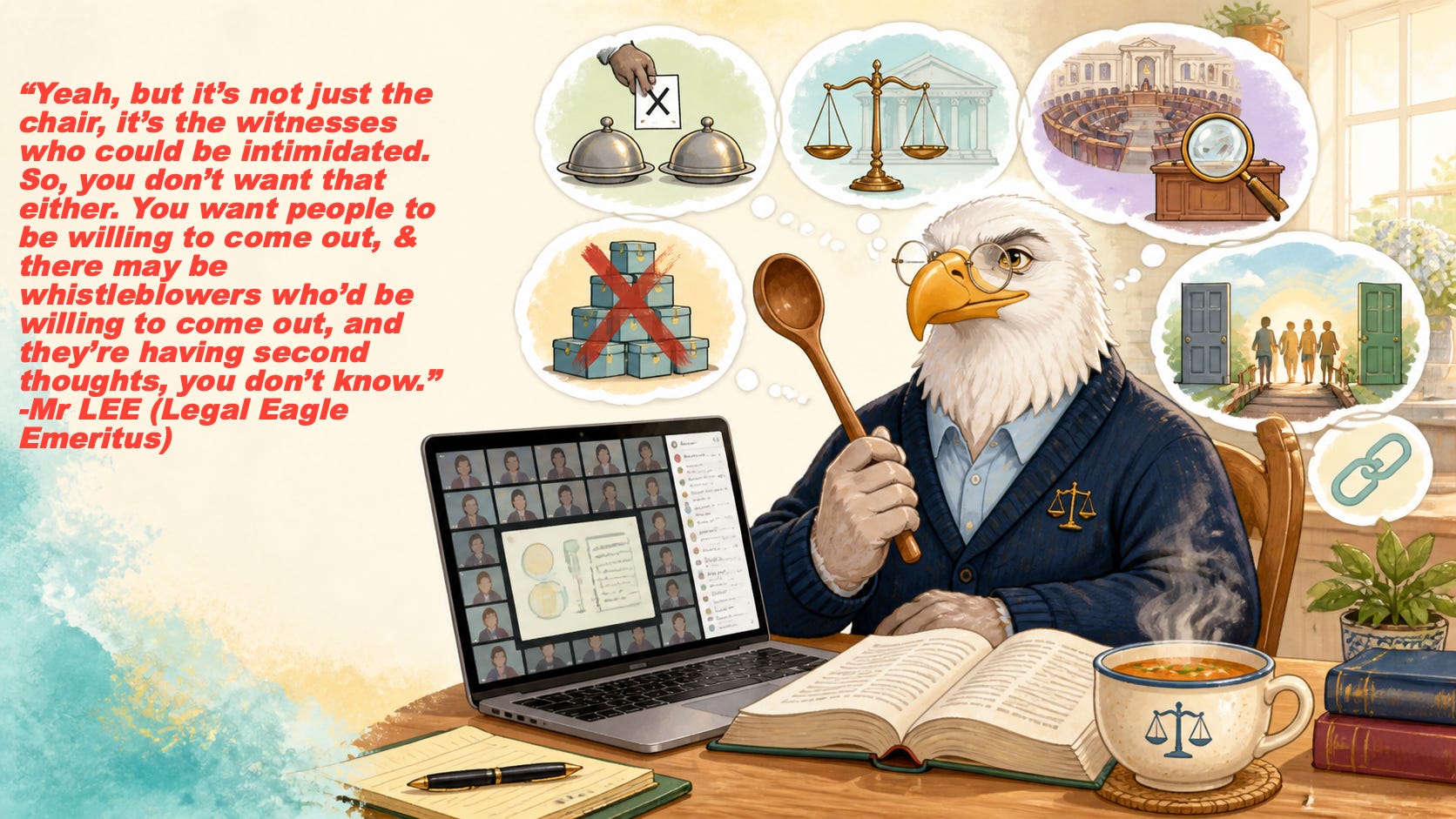
“It’s not just the chair, it’s the witnesses who could be intimidated.”
That distinction shifted attention from a prominent official’s public confidence to the less visible risks facing witnesses and potential whistleblowers. Alice acknowledged the correction and the importance of recognising costs that people watching from relative safety might overlook.
His public-chat contributions
Mr. LEE clarified that the measure participants called the “BAAJA Act” had advanced through a procedural vote but had not, in his account, received final passage. He warned that the Senate could act at any time. He also acknowledged the associated call to action, exchanged holiday wishes, and thanked Hazel for looking out for him during a lighter chat exchange.
No standalone web link from Mr. LEE appears in the supplied public chat.
🌍 WHO GETS A SEAT—AND WHO GETS PROTECTION?
Alice described a meeting involving Donald Trump, Xi Jinping, and Vladimir Putin, inviting the room to distinguish public declarations from enforceable settlements and to notice whose interests were absent.
“A summit is not a settlement.”
She paired that with discussion of a reported Myanmar judgment concerning the Rohingya. The question was not simply whether a court had spoken, but what a ruling could deliver without credible enforcement. During the presentation, she distinguished the International Court of Justice from the International Criminal Court; later remarks sometimes blurred the institutions, so the discussion should not be read as a precise legal-status guide.
Dr. Mellow Marigold wondered whether the language of spheres of influence reflected a wider effort to undermine international structures in which other nations had a voice. She presented this as an interpretation, not an established finding.

🐾 Ms. Verity Justice Onyx: expectations need to meet reality
Ms. Verity Justice Onyx, Retired Civil Rights Attorney & Shero, followed Mr. LEE with a challenge: why expect leaders who disrespected legal constraints at home to respect them internationally?
“The reality is we need to understand where we are and why we are the way we are.”
She connected that concern to money, power, media incentives, and the erosion of international confidence in the United States. Her contribution asked the room to hold onto its expectations of justice without mistaking those expectations for a description of how power was currently operating.
The discussion’s shared concern was practical and human: what would protection, restitution, and accountability mean for people living with the consequences? Specific claims about summits, court rulings, and legal status remained participants’ reported discussion rather than findings independently established by this newsletter.
💻 SYSTEMS DOWN, QUESTIONS UP
Aviation, email, banking, and other technical disruptions formed another major strand of Alice’s presentation. She described possible connections involving older infrastructure, rushed updates, and AI-assisted discovery of vulnerabilities, while separating plausible explanations from proof.
“We can demand an explanation without pretending we already have one.”
Milo Merriquip suggested in public chat that updates responding to rapidly discovered vulnerabilities might not have been adequately tested. Alice’s presentation acknowledged that a shared AI cause had not been established. Later, she expressed stronger suspicion about the cluster of disruptions and urged people to demand an account of what had happened; that suspicion was not evidence establishing a common cause.
The takeaway was a demand for transparency: what failed, what evidence supported the explanation, and what would change? The room did not establish that it had solved the outages.
That distinction mattered again when Junia Hearthsong wondered whether recent disruptions might be used to justify more data-centre construction. Her concern was a question about incentives, not evidence establishing a causal connection.
🩺 HEALTH INFORMATION WITHOUT THE PUBLIC SHAMING
Discussing reports about measles and sustained transmission, Alice asked how communities could protect one another without turning illness into a moral judgment. She urged the room not to make vaccination histories a public inventory or honest questions a source of humiliation.
Public chat became a practical extension of the discussion. Attendees asked about older vaccination histories, requested sources, and discussed taking questions about immunity to their clinicians. An attendee shared excerpts attributed to Immunize.organd Mayo Clinic Press. Another recommended Mayo Clinic, while cautioning:
“Don’t try to self-diagnose, use it responsibly.”
Tansy Trailwhistle, Pedalling News Scout & Two-State Pathfinder, urged attention to Pennsylvania reporting and recommended qualified health professionals and established professional or public-health organisations rather than relying on “Dr Google”. Hazel thanked contributors and said she would look into her own questions. Drake welcomed the idea of consulting a doctor rather than assuming the chat could settle an individual medical decision.
The exchange included personal experiences and different vaccine questions. It is not a blanket vaccination recommendation.
🌾 THE FARM BILL: FOLLOW THE FOOD DOLLAR
Alice wanted more attention paid to the Farm Bill—and less assumption that it mattered only to people who owned tractors.
She distinguished the shelf price of food from a household’s ability to afford it. Supporting producers, strengthening food assistance, and lowering checkout prices were connected goals, but they did not necessarily operate through the same mechanism.
Using a graphic she attributed to USDA, Alice cited a farm share of 18.9 cents per dollar for domestically produced food purchased for home consumption in the data she presented. She emphasised that the remainder was not simply supermarket profit: it included processing, transport, wholesaling, retailing, and other activity. That figure was context, not a breakdown of every item in a shopping basket. She also distinguished broad food-supply estimates from the higher import shares she discussed for fresh fruit and vegetables.
Her policy test cut through the slogans:
“Help whom? Through which provision? And how would we know it worked?”
Drake connected food prices to distribution and fuel costs. Briar later raised the effects of labour shortages. Tansy brought a Pennsylvania perspective, discussing agricultural committee leadership and drawing attention to SNAP, WIC, and nutrition.
The question was how a bill could support stable farms, affordable food, and environmental protection—and how constituents could make those priorities specific enough to evaluate.
🏭 IOWA: ALICE EXPLAINS THE PLANNED DETONATION—AND WHY THE AFTERMATH MATTERS
Briar brought the discussion to Iowa with a question that made room for everyone who had missed the story:
“Where did it come from? Why are they doing that?”
Alice described a planned Army disposal operation involving deteriorated lead azide at the Iowa Army Ammunition Plant near Middletown and Burlington. This was discussion of a proposed detonation—not an explosion participants were reporting had already occurred.
The following reconstructs Alice’s explanation and the room’s responses on Thursday evening. Operational details, legal status, projections, and safety instructions are reported as discussed then; this is not a current emergency bulletin or independent verification of the disposal plan.
🐘 What was being detonated—and when?
Alice said the Army planned to detonate 9,500 pounds of deteriorated lead azide, which she described as an explosive chemical. She placed the proposed operation around noon the following day—Friday, 20 November, in the meeting’s chronology.
Her explanation was that authorities were dealing with an existing hazardous stockpile, rather than introducing a new material or conducting an ordinary demolition project.
Later, she added that the lead azide had been stored at the plant for more than twenty years in an ethanol-and-water mixture intended to keep it stable. She also said officials had known about the problem for months, “since March”.
Those details sharpened her criticism of the short warning period. In her telling, a long-standing storage problem had reached an urgent stage; it had not simply become known a few days before the planned operation.
The meeting did not establish the material’s manufacturing date. An attendee wondered whether it dated to the Second World War, and Sir Talliver briefly agreed, but no documentation was presented. That possible origin is not treated here as confirmed.
Why not move it—or leave it where it was?
Briar asked:
“Why can’t they just keep storing it wherever it was stored?”
Alice relayed the Army’s position that the explosives were too dangerous to move. She explained the rationale for a planned detonation as concern that unstable material could otherwise explode unpredictably: authorities wanted a scheduled operation rather than an uncontrolled event.
Thanks for reading! This post is public so feel free to share it.
An attendee recalled the Moderator’s earlier explanation that the material might otherwise explode on its own timetable. That was a reference to an earlier discussion, not a new contribution from the Moderator during this meeting.
Ms. Laurel Lightkeeper added that the material had become more sensitive to friction or shock. In public chat, Iris Emberwing said she understood that colder conditions could make it more crystallised and unstable. She also wondered whether liquid loss had contributed and whether anything could be injected to stabilise it. Those were her account and questions; the meeting did not establish the precise mechanism or show that reinjection was a viable option.
Alice acknowledged the tension rather than resolving it: if the material could not safely be transported, residents still deserved evidence explaining why detonating it near their communities was the safest available course.
“Residents are asking why detonating them near their communities and potentially spreading the lead dust is the safest option and demanding evidence, clear warnings, and accountability.”
The concern was not only the blast
Alice said the detonation could release lead-containing dust that might drift into surrounding communities and settle on surfaces. The concern extended beyond the immediate noise or force of an explosion to what might remain after airborne dust was no longer visible.
She said forecast maps had changed with updated modelling. Earlier warnings had extended as far as 100 miles, while newer projections showed a smaller footprint. The meeting did not provide those maps, their assumptions, a final boundary, or exposure measurements. The earlier distance should not be read as a confirmed contamination radius or a current evacuation zone.
Alice identified children and pregnant people as particular concerns in the discussion of lead exposure. Ms. Laurel focused on playgrounds, farmland, and surfaces where material might settle. Chat contributors asked about food and water. No measured contamination in any of those places was established during the meeting.
An attendee’s public-chat comment distilled the worry:
“It’s the aftermath we are concerned about.”
What residents had reportedly been told
Alice said nearby residents had been advised to leave during the operation or shelter indoors if they could not, and that some schools had cancelled classes. Another attendee mentioned evacuation requests in chat.
These were reports of advice circulating at the time, not a complete set of official instructions. The transcript did not supply a verified evacuation map, a sheltering duration, an all-clear procedure, or detailed guidance about ventilation, outdoor belongings, food, water, or cleanup. This recap does not invent those missing details.
Iris also reported that sand would be placed over the material before detonation. The meeting did not establish how much sand, the engineering specification, or what protection it would provide. Another attendee questioned whether that was enough and why residents had not received more time and a clearer explanation of alternatives.
Short notice, alternatives, and the lawsuit
Alice identified several unresolved accountability questions:
- Why had residents received so little notice if the stockpile and deterioration were long-standing concerns?
- Had safer alternatives been adequately assessed, and could the evidence be explained publicly?
- What would happen to any contamination after the immediate airborne dust cleared?
- Who would be responsible for monitoring, communication, and the consequences?
Briar said she had heard the warning period was about five days. Another attendee used the same figure in chat; it was not independently documented during the meeting.
Alice reported that environmental groups had filed suit that day seeking to halt the operation. She distinguished filing a lawsuit from obtaining an order stopping the plan: at that point in her account, the operation had not been stopped. The transcript supplied no case number, filing, court order, or subsequent ruling.

🪶 Ms. Laurel Lightkeeper: this was family, not an abstract footprint
For Ms. Laurel, Respite Strategist & Thriving Advocate, the issue was immediate. She said younger generations of her family lived in the area and that some had not known what was being planned.
Her concern extended beyond the operation to the places children played and the land that produced food. She urged family members to raise their concerns publicly:
“I’ve asked my family there to start speaking up.”
She also raised the possibility of legal action, expressing anger about what she saw as a wider pattern of public-health and environmental failures. Those were her arguments and concerns—not a finding that a particular legal claim had been established or that exposure had already occurred.
Alice acknowledged her passion. The ageing stockpile, reported months-long awareness of the problem, and compressed public-warning period were what made the situation so troubling to her.
The questions were the point
Briar made the problem understandable without pretending it was simple. Alice supplied the account available to her. Ms. Laurel made the human stakes unmistakable. Iris and other chat contributors kept attention on protective measures, alternatives, and the period after the immediate operation.
Alice told Briar:
“You’re asking the right questions.”
The room did not determine whether the proposed operation was safe or establish what subsequently happened. It made clear what participants wanted: evidence, meaningful warning, an explanation of alternatives, and accountability that lasted longer than the dust cloud.
🏙️ JUNIA HEARTHSONG: THE LOCAL AGENDA DESERVES YOUR ATTENTION
Junia Hearthsong, Garden-Tender, Clear-Eyed Encourager & Backbone Brigade, brought the later conversation to data centres and local decision-making.
She described a Rockford zoning process, more than six hours of public testimony, and frustration that proposed restrictions would apply to future developments rather than an already approved project. Her account included residents asking for further research and a delay, and an attorney delivering a detailed critique of the proposed language.
“We’re going to find a solution because this is crazy.”
Junia also questioned the incentives behind further infrastructure expansion. Her earlier suggestion that disruptions might be used to justify more data centres remained speculation, not a demonstrated link.
Briar connected the wider discussion to constituent pressure, recalling an impassioned public comment and arguing that urgency could be communicated without imitating someone else’s exact words. Milo supplied the comic contrast:
“I’m going to send you a very sternly-worded letter!”
The underlying point survived the joke: people wanted action, not a polished performance of concern.

🧠 THE CL1: LIVING CELLS, SILICON & SOME VERY HUMAN QUESTIONS
During the data-centre exchange, Alice introduced the CL1 as an example of a different direction in computing. Junia responded with interest, while attendees asked about the source of the biological material and raised bioethical concerns.
Alice’s immediate reaction captured both curiosity and discomfort:
“And now, does this freak me out? Yes, yes, it does.”
She also discussed quantum computing and Illinois investment as another possible direction. The meeting did not supply technical evidence establishing the comparative capacity or resource savings of those different approaches. Biological and quantum computing should not be treated as interchangeable technologies.
🎥 A post-meeting follow-up: two videos, clearly attributed
The newsletter editor subsequently supplied Reuters’ “This computer runs on living human brain cells”, published 6 March 2025, and AI Revolution’s “They Just Made a Chip With Living Human Brain Cells”, published 17 August 2026.
These were not public-chat submissions during Thursday’s meeting. The second is a newer explanatory overview, not another Reuters report or a peer-reviewed study.
What the CL1 actually combines
Reuters describes the CL1, developed by Melbourne-based Cortical Labs, as a commercial biological computer combining living neurons with silicon hardware. Tiny electrical contacts connect the neural network to digital equipment. The company calls the approach synthetic biological intelligence.
The distinction is neurons with silicon, not neurons replacing every computer chip. Nor is this a whole human brain installed in a computer.
The Reuters report describes an artificial life-support system, including pumps, feeding and waste reservoirs, filtration, and a gas mixer handling oxygen, carbon dioxide, and nitrogen. Keeping the cells alive is part of the system’s operation.
Where the cells come from
In Reuters’ report, a company representative explains that blood or skin cells can be transformed into stem cells and then neurons. That is more precise than the meeting’s suggestion that the system relies on donated whole brains or tissue from people who donate their bodies to science.
The newer overview describes cultures derived from the company founder’s stem cells. Neither source supports treating donated cells and donated whole brains as interchangeable descriptions.
Learning demonstrations—and research applications
AI Revolution’s overview describes neural cultures receiving electrical feedback in game-based demonstrations involving Pong and Doom. These provide a way to explore adaptive behaviour; they are not proof of human understanding or general-purpose intelligence.
The video also broadens its scope to brain-organoid research at UC San Diego and Johns Hopkins. Those projects belong to a related research landscape, but they are not all the CL1. Neural cultures on chips, three-dimensional organoids, and disease-modelling systems should not be collapsed into one device.
Reuters highlights proposed applications in drug discovery and personalised medicine, including the possibility of growing patient-derived neurons and testing compounds on them. The newer video similarly discusses studying learning, memory, disease, and drug effects.
A platform can be valuable for laboratory research without replacing a conventional data centre.
Why the ethical questions belong at the table
The August overview discusses donor consent, biological material, possible future moral status, and disagreement about terms such as sentience and consciousness. It describes criticism of consciousness-related language rather than establishing that the CL1 or a brain organoid is conscious.
Responding to signals or improving at a narrowly defined task does not, on the evidence presented in the overview, settle whether a system has subjective experience. The ethical discussion is about uncertainty and governance—not an announcement that researchers have created a conscious person in a dish.
Promise is not the same as a proven replacement
Reuters attributes faster learning and lower energy use to the company’s claims. Neither video, by itself, establishes a quantified water-saving comparison with conventional data centres or demonstrates that CL1 systems can replace their full range of workloads.
The sources also do not establish that U.S. adoption decisions can be explained solely by profit motives, as participants speculated during the discussion.
Alice brought a real emerging technology to the table. The strongest follow-up keeps both parts of that sentence: real and emerging. Junia’s questions about infrastructure, public resources, and accountability remain important without requiring a promise that the replacement has already arrived.
🔬 WHEN SCIENTISTS LEAVE, THEY DO NOT LEAVE ALONE
Dr. Mellow Marigold widened the frame to the professional communities around research. Drawing on a personal encounter, she described a science-related lawyer considering a move to Canada and observed that scientific migration could draw related work along with it.
“Once you got the scientists moving away, you got a bunch of people who would normally be working with scientists who are then relocating.”
She, Alice, and Briar discussed research funding, international students, university finances, and the economic and institutional consequences of losing researchers.
Tansy added that other countries were recruiting scientists and graduate students, then connected higher education’s struggles to demographic change and the health of a university town she knew. She also raised concerns about special education and the Department of Education.

Alice described what a university contributes beyond its payroll: culture, art, theatre, learning, and opportunities throughout the surrounding community. Her comments about potential institutional closures were expressions of concern during the meeting, not confirmed closure announcements.
Ms. Laurel brought the discussion down to public schools, recounting reports of shortened school weeks and urging attention to city-council appointments during political transitions. Iris noted bus cuts in some areas. These remained contributors’ accounts rather than independently checked findings about particular districts.
Alice suggested reading-support programmes for children and adults as one possible local response. Tansy recalled a literacy programme lost to funding constraints, while noting that after-school support remained. Iris responded:
“I love that idea! I will think about that! I used to tutor kids in reading.”
A large conversation about systems had arrived at a concrete possibility: help someone read.
✨ GOOD NEWS: A SIGNAL, A TURBINE & SOMETHING UNDER BÉCHAMEL
Alice’s good-news offering came from well outside the daily news cycle: Voyager 1. She described reports of the spacecraft reaching roughly one light-day from Earth and of power-saving work that might extend communications, while acknowledging that extra years were not guaranteed.
The appeal was persistence—a distant spacecraft still sending a signal when much closer institutions seemed unable to communicate clearly.
Nearer home, Iris reported seeing new wind turbines going up around her. Community members celebrated the willingness of residents to testify, ask questions, and refuse to disappear from local decision-making.
🦦 Kai Harbourlight’s contribution to collective morale
Kai Harbourlight, Bay Guardian & Democracy Steward, shared The Telegraph’s report about Denmark’s record-setting oldest woman and a Nazi Party past and an Intelligencer article about Trump, MAGA, and far-right political factions. These were shared reading, not independently verified findings of the meeting.
He also contributed screenshots associated with Nancy Pelosi’s commendation ceremony and a dinner announcement:
“Making a white lasagna tonight with clove flavored beef.”
Followed by:
“Triple bechamel sauce.”
Iris confessed:
“I read that as wine lasagna first.”
Some weeks, good news arrives from interstellar space. Some weeks, it arrives under béchamel.
The screenshot filenames are not live links, and the dinner description was not a complete recipe.

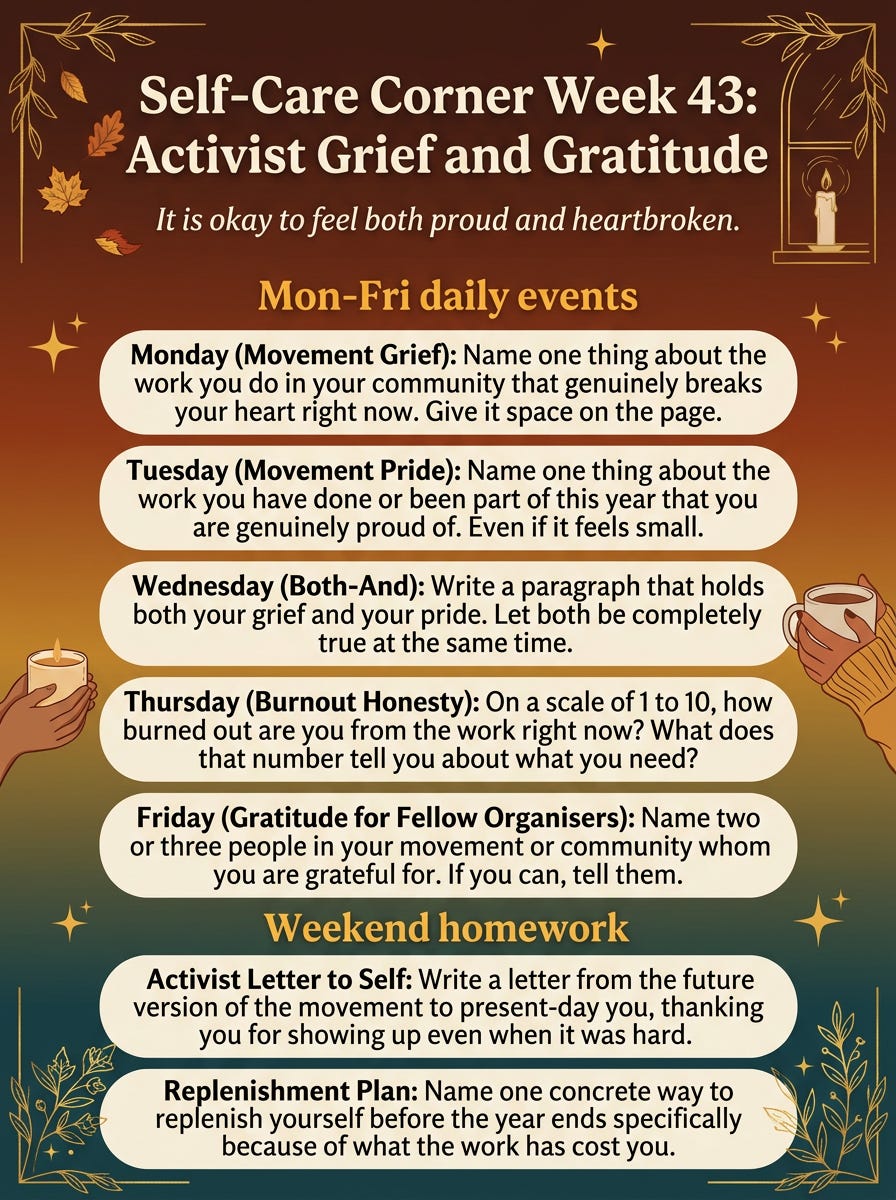
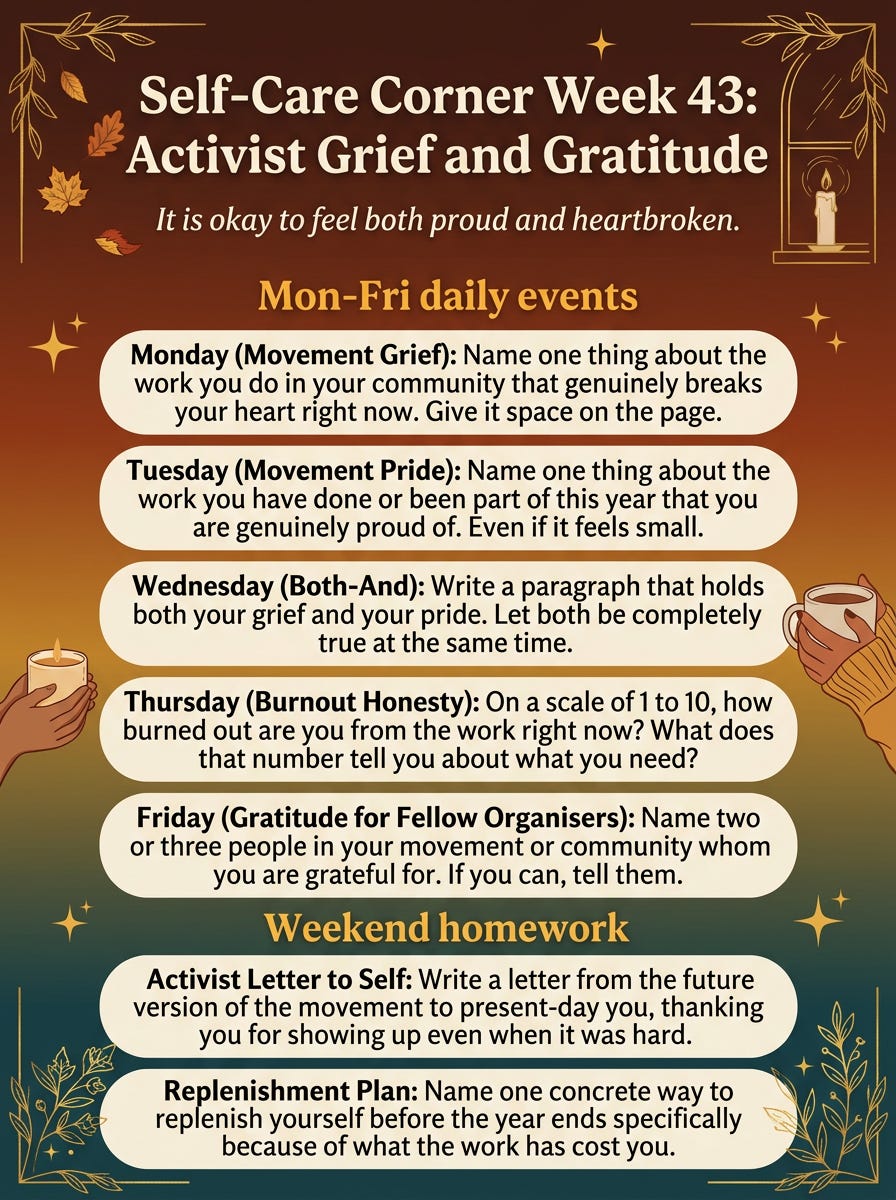
🫖 SELF-CARE CORNER: YOUR PRESENCE IS THE OFFERING
Self-Care Corner moved from Permission to Opt Out towards The Gift of Stillness. Alice’s message was not that everyone needed a more efficiently managed holiday. It was that not every expectation deserved a place on the calendar.
“You do not owe anyone your holiday energy.”
Her invitations were specific:
- Write down seasonal obligations and identify which ones you genuinely choose.
- Decline, skip, or simplify an obligation rooted in someone else’s expectations.
- Separate genuine joy from duty, leaving room for quiet, non-festive restoration.
- Name three things to say yes to and three things to protect yourself from.
- Put screens away for five quiet minutes. Notice sounds, textures, and temperature without planning or scrolling.
- Give someone twenty minutes of undivided attention, without multitasking.
“Let being present be enough.”
Dr. Mellow Marigold answered the seasonal yes-and-no exercise in chat with welcome specificity: yes to cranberry sauce and gluten-free, dairy-free pumpkin pie, a softer yes to apple pie, and some negotiation over potatoes and squash.
📣 CALLS TO ACTION: PICK ONE THING & KEEP SHOWING UP
Calls to Action were woven through the gathering rather than saved for an ornamental final slide.
1. Choose an issue you can return to
Alice’s answer to overwhelm was focus:
“So pick one thing.”
Choose an issue that moves you, contact the representatives responsible, and keep showing up. Ms. Laurel named healthcare in chat; others named lawlessness and lack of accountability. Briar encouraged people to communicate genuine urgency rather than feeling obliged to sound timid. Taking a break did not mean abandoning the work.
2. Pair oversight with material improvements
Mr. LEE urged pressure for both investigations and policy delivery. Drake insisted that food and healthcare remain central. Hazel defended equal accountability under the law. Together, their contributions offered a fuller standard than either political spectacle or legislative caution alone.
The discussion also highlighted the safety of witnesses and whistleblowers, not simply whether a committee chair appeared fearless.
3. Make the constituent question specific
Hazel said she wanted to research Senator Tammy Baldwin’s record and ask about leadership choices and Gaza. Milo cautioned against assuming that one leadership endorsement meant agreement with every policy position, suggesting a direct question about accountability instead.
Hazel welcomed the refinement:
“Don’t want to call without a few facts.”
That exchange modelled a useful combination: research, moral clarity, and a question an office could actually answer.
4. Follow up on the campaigns raised in chat
An attendee relayed an Indivisible campaign supporting Chris Van Hollen for Senate leadership. Another urged opposition to the measure called the “BAAJA Act”. Mr. LEE clarified the distinction between procedural advancement and final passage; Milo discussed the changing cloture tally, and Tansy relayed commentary about the bill’s components, including offshore wind.
5. Ask for explanations without inventing certainty
The outages discussion called for evidence and transparency. The Farm Bill discussion called for identifying who benefits, how, and with what measurable result. The Iowa discussion called for warning, alternatives, and accountability beyond the immediate operation. None of those demands requires pretending every unanswered question has already been resolved.
6. Keep local government on the radar
Junia’s zoning account and Ms. Laurel’s warning about appointments during transitions pointed towards council agendas, public hearings, and the rules determining which projects receive protection or exemption.
7. Share health information responsibly—and keep human survival central
Alice encouraged sharing trustworthy health resources without turning private medical histories into public discussion. She also urged participants not to lose sight of people experiencing war, displacement, and suffering while navigating domestic political crises.
Her larger question was what accountability actually changes for the people whose lives depend on it.
8. Turn care into something practical
Consider whether a local reading-support effort could use your skills. Use the community to process difficult feelings. And, in Alice’s self-care framework, protect enough energy to remain a person—not merely a delivery system for other people’s emergencies.
📚 FROM THE NOTICEBOARD
Alice shared these schedule notes during the meeting. Times are reproduced as announced; time zones were not consistently specified, and registration links were not supplied.
- Self-Care Salon: Saturday at 11 a.m., with a storytelling component planned.
- Sunday book discussion: the final session of This Is the Plan, at 4 p.m.
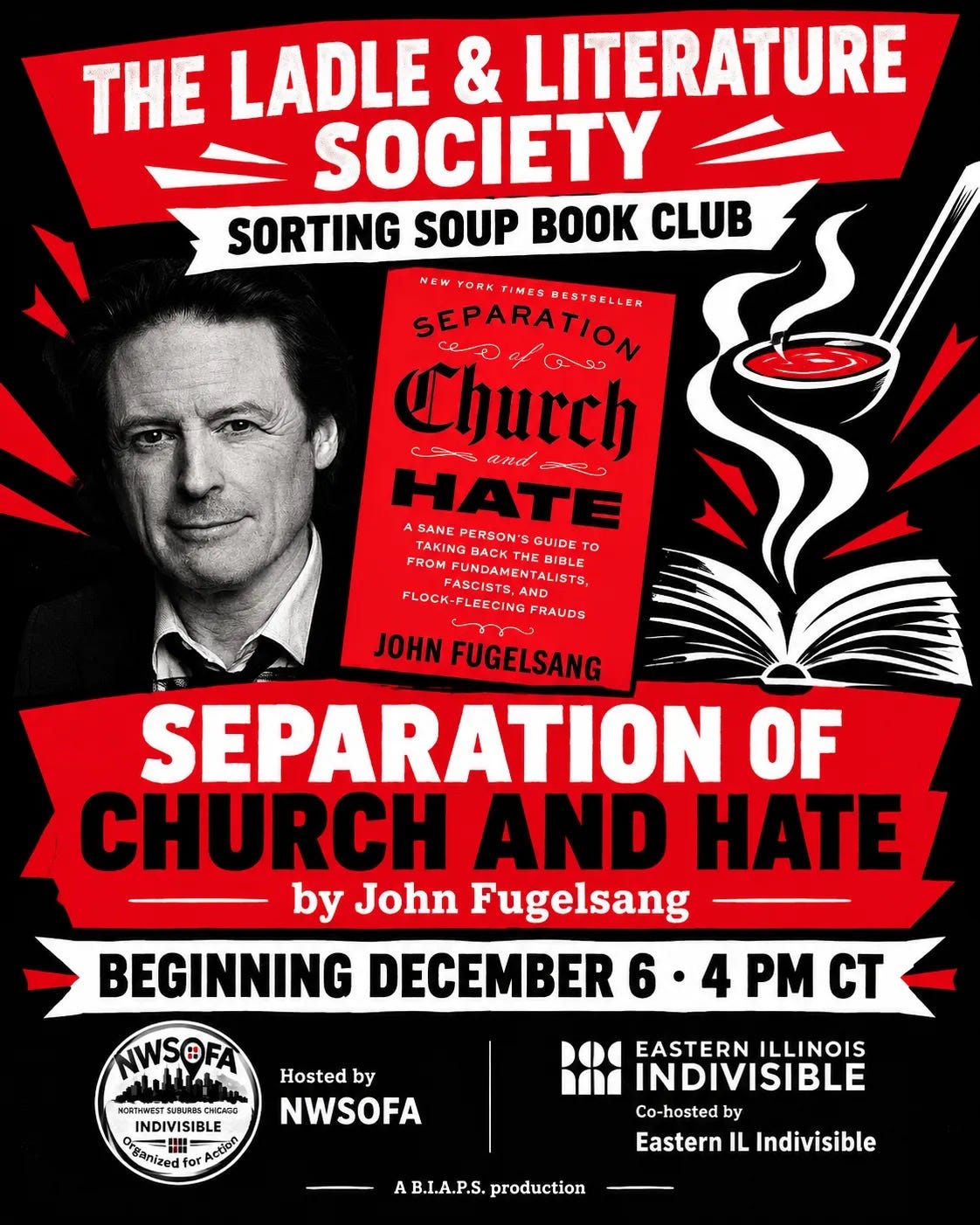
- Beginning 6 December: Let This Radicalize You, including enthusiasm for its accompanying workbook and its connection between organising and collective care. This will be the 9am [CT] offering.
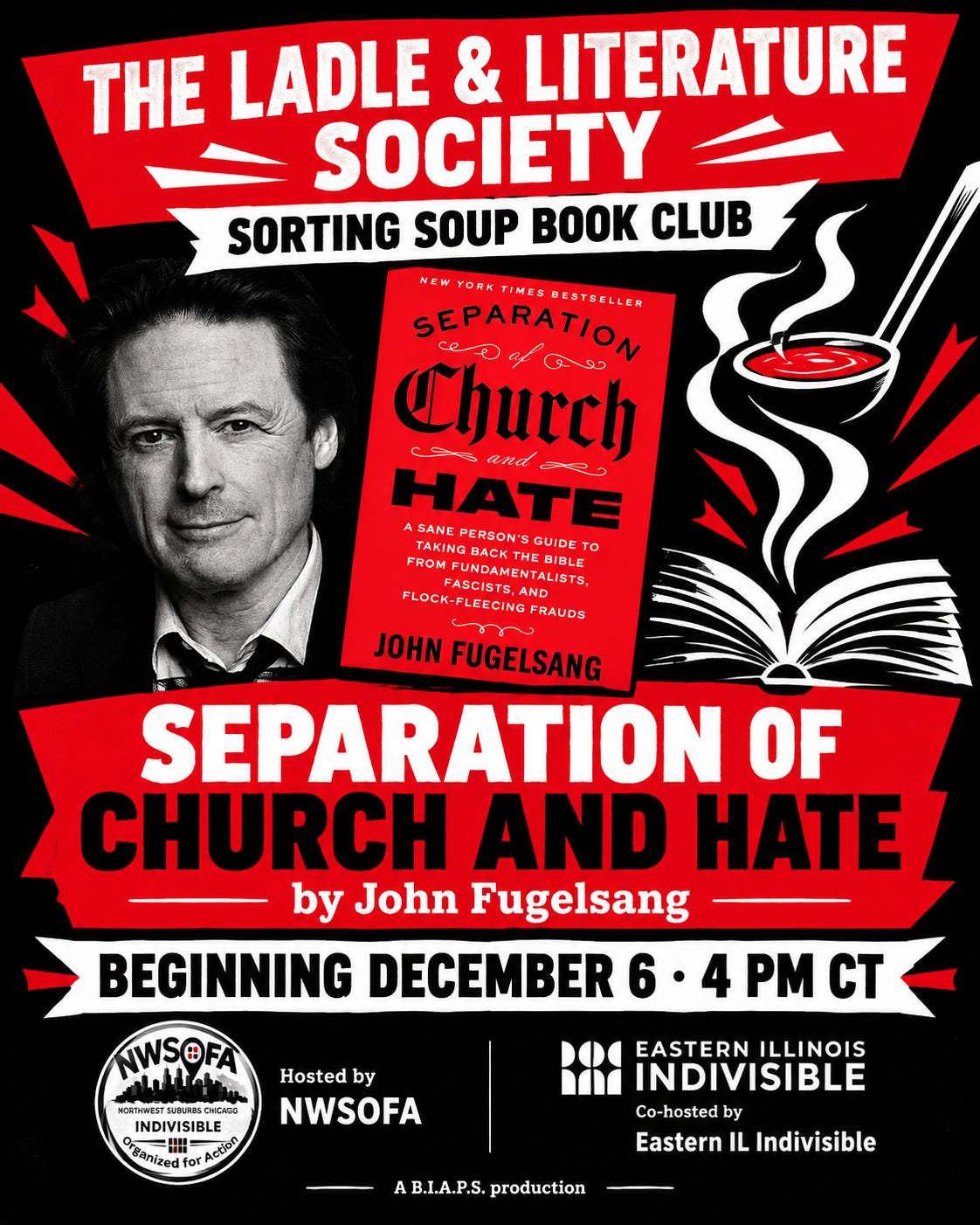
- Another upcoming title mentioned: The Separation of Church and Hate by John Fugelsang, which will be the 4pm [CT] offering.
- Thanksgiving Thursday: no Sorting Soup the following week. An attendee’s question helped bring that announcement into the discussion before the closing reminders.
- Other gatherings announced: the next morning’s Coffee & Conversation, including an 8 a.m. Early Birds start, and that evening’s 7 p.m. gun-violence-prevention meeting.
An attendee also recommended Gil Duran’s The Nerd Reich and his appearance on Jon Stewart’s The Weekly Show.
For those who want to revisit the conversation, Sir Talliver shared the Sorting Soup recording on YouTube. Unlike this written recap, the public recording may contain participants’ names, voices, and images.

🥣 THE FINAL LADLE
By the end of the evening, the room had not solved international enforcement, rewritten the Farm Bill, or settled the future of computing. It had done something more honest: made the questions clearer, listened when someone complicated an easy answer, and found places where concern could become action.
Mr. LEE reminded everyone to think about the witness, not only the committee chair. Drake kept food and doctors in view. Ms. Verity asked the group to look squarely at how power operated. Ms. Laurel brought family and children into a discussion that could otherwise have stayed technical. Junia brought the local agenda. Tansy, Hazel, Milo, Iris, and Kai kept public chat full of context, challenge, warmth, and occasional béchamel.
And Dr. Mellow Marigold’s opening exercise remained relevant all the way through: a worry can matter without occupying every available inch of you.
The closing exchange supplied the right seasoning. When Alice mentioned Thanksgiving plans at a best friend’s home, Briar asked, “You’re coming over?” Alice clarified that friendship had several regional headquarters and awarded Briar the whole state of Michigan.
Briar’s verdict:
“You’re so weird.” 😜
Sir Talliver Guidelight praised the conversation and wished everyone a happy Thanksgiving before closing the gathering a little before the scheduled half-hour.
Sort what you can. Set down what you must. Ask the question. Make the call. Eat something nourishing. There will still be room at the table when you return. 🦋 🖇️ 🥣
🔗 LINK LIBRARY
Every explicit web URL or website address shared in the supplied public chat is gathered here, alongside the two clearly labelled post-meeting resources. Contributors use designated pseudonyms where supplied. Descriptions of shared articles reflect what was posted, not independent verification of their contents. Screenshots are not live links.
🎥 MEETING REPLAY
- Watch the Sorting Soup recording on YouTube — shared by Sir Talliver Guidelight. The public chat identified this as the NWSOFA-Indivisible recording. Unlike this anonymised newsletter, the recording may contain participants’ names, voices, and images.
📰 NEWS & POLITICAL READING
- The Telegraph: report about Denmark’s record-setting oldest woman and a Nazi Party past — shared by Kai Harbourlight, Bay Guardian & Democracy Steward.
- New York Magazine / Intelligencer: Trump, MAGA, South Carolina, and far-right political factions — shared by Kai Harbourlight, Bay Guardian & Democracy Steward.
🩺 HEALTH INFORMATION
- Mayo Clinic — website address shared by an attendee without a supplied pseudonym, as a resource to consult responsibly before speaking with a clinician. The chat supplied the domain, not a particular article.
🧠 SCIENCE & EMERGING TECHNOLOGY | POST-MEETING RESOURCES
Both resources below were supplied by the newsletter editor after the meeting, as follow-up to Alice Everwell and Junia Hearthsong’s discussion. Neither was a link shared in Thursday’s public chat.
- Reuters: “This computer runs on living human brain cells” — 6 March 2025. News report introducing Cortical Labs’ CL1, its biological–electronic architecture, cell sourcing, life support, and proposed research applications. Efficiency and performance statements are attributed to the company.
- AI Revolution: “They Just Made a Chip With Living Human Brain Cells” — 17 August 2026. Broader explanatory overview of CL1, neural-learning demonstrations, related organoid research, and ethical debates. It is not a Reuters production or a peer-reviewed study.
📌 MENTIONED, BUT NO DIRECT URL SUPPLIED
Participants also mentioned Immunize.org, Mayo Clinic Press, professional health organisations, Indivisible’s Senate-leadership campaign, the group’s Linktree, book discussions, Self-Care Salon, and the Gil Duran interview. No direct URLs for those resources or events appear in the supplied public chat, so none have been invented.